A mature, community-owned ERP with tier-1 accounting depth, a metadata-driven design and no licence fee. Here is where it came from, what its licence actually permits, how the community runs it — and, just as importantly, what it is not.
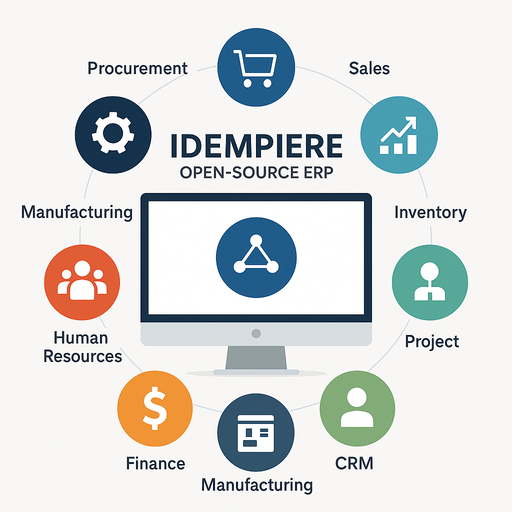
iDempiere is a fully integrated ERP, CRM and supply-chain suite. In one system it handles general ledger, receivables and payables, purchasing, inventory, manufacturing, sales, projects and more — all posting to a single accounting engine, with no interfaces to reconcile between modules.
Technically it is a Java application built on the OSGi module system (Equinox), served through the ZK web client, and running on PostgreSQL or Oracle. What makes it unusual among ERPs is the Application Dictionary: windows, tables, fields, validation rules, workflows and reports are stored as metadata. You reshape the system by configuring that metadata rather than by editing source, which is the reason customizations can survive version upgrades.
It is released under the GPLv2 open-source licence. There is no per-user fee, no module unlock charge and no annual audit letter. You get the source code, the database schema and full control over where and how it runs.
iDempiere did not appear from nowhere. It is the third generation of a codebase that has been forked twice, each time over how open the project should really be.
Jorg Janke founded Compiere as one of the first commercial open-source ERPs. Its ideas were ahead of their time: a single integrated ledger, the data-dictionary approach and a smart-client architecture. But the sponsoring company kept tightening control over the code and the roadmap, and the community grew frustrated that "open source" felt increasingly like a marketing label.
In September 2006 the community forked Compiere and named the result ADempiere, governed as a genuine community project rather than a single company's product. ADempiere carried the functional richness forward and added features, but it inherited Compiere's ageing Swing client and monolithic build, which made the code hard to extend cleanly.
Led by Carlos Ruiz and Heng Sin Low, a group re-platformed ADempiere onto OSGi, Equinox and Maven, replacing the monolith with a modular plugin architecture and standardising on the ZK web client. The goal was technical: make the ERP genuinely extensible without patching the core. That project became iDempiere, and it is the line that remains actively developed today.
Compiere is now a proprietary product under different ownership, and ADempiere still exists but has slowed markedly. iDempiere is where the community energy, the release cadence and most new implementations now sit — and it is the version we build on.
Same ancestry, different destinations. If you are running Compiere or ADempiere today, this is the practical picture.
| Dimension | Compiere | ADempiere | iDempiere |
|---|---|---|---|
| Origin | Original, from 1999 | Fork of Compiere, 2006 | Fork of ADempiere, 2011 |
| Licensing today | Proprietary / commercial | GPLv2 open source | GPLv2 open source |
| Primary client | Swing desktop | Swing desktop / early ZK | ZK web client |
| Architecture | Monolithic | Monolithic | OSGi modular plugins |
| Build system | Ant | Ant | Maven / Tycho |
| Active development | ✘ Closed roadmap | Limited | ✔ Active, ~2 releases/yr |
| Upgrade-safe extensions | Difficult | Difficult | ✔ By design |
Migrating from an older cousin? Compiere and ADempiere share iDempiere's data model closely enough that migrations are well-trodden. See Migration & Upgrade for how we carry data and customizations forward.
"Open source" gets used loosely. Here is what the GNU General Public License version 2 means for you in practice, without the ideology.
Use iDempiere for any purpose, on any number of servers, for any number of users, in any country. There is no metering, no activation key and no clause that lets anyone charge you per seat.
Study the source, change it and deploy your changes internally. As long as you do not distribute the modified software to a third party, GPLv2 imposes no duty to publish anything you build.
If you hand the modified software to someone else, you must offer them the corresponding source under GPLv2 too. Running your own internal ERP — even a heavily customized one — is not distribution.
The practical takeaway. For the overwhelming majority of companies, iDempiere is simply free enterprise software they own and extend behind their own firewall. The copyleft obligations only matter if your business model is redistributing the ERP itself.
iDempiere has no owning corporation. It is governed by its community of committers and contributors, coordinated through public mailing lists, a Git repository and an open issue tracker. Decisions on the roadmap are made in the open, and any organisation can contribute fixes and features back.
The community cuts roughly two releases a year, tagged by year and month. Most enterprises do not chase every release. In practice they adopt a version, run it for one to three years with periodic patches — an LTS-style discipline the community supports through maintenance branches — and upgrade on a planned cycle rather than continuously.
Because a well-built implementation keeps customizations in OSGi plugins and Application Dictionary metadata, upgrading is a controlled migration and regression pass, not a rebuild. That is what lets a business stay current without fear.
It tends to win in the small-to-upper-mid market, wherever a company wants serious accounting and inventory depth without tier-1 licensing — and cares about owning its source and data.
Discrete and process manufacturers using BOMs, routings, work orders and standard-versus-actual cost variance across plants.
Multi-warehouse distributors and third-party logistics operators needing bin control, landed cost and multi-client billing.
Batch, lot and expiry tracking with FEFO picking and recall traceability, where an audit trail is non-negotiable.
Project-driven firms tracking WBS, timesheets, work-in-progress and milestone billing against profitability.
Setting expectations correctly is how projects succeed. iDempiere is powerful, but it is not everything a glossy vendor pitch might imply.
Nobody hands you a login and a monthly bill. You (or a partner) deploy and run it. That is the price of owning it.
It is a strong horizontal platform. Industry-specific behaviour comes from configuration and extensions, not a pre-packaged edition.
Support comes from a partner you engage, your own team, or the community — there is no toll-free number attached to the licence.
The ZK client is functional and dense rather than consumer-slick. It rewards trained operators over casual users.
Core HR and payroll are basic; most companies localise them or integrate a specialist system. We are candid about this up front.
Getting real value needs someone who understands accounting schemas, document workflow and the Application Dictionary.
Why we say this out loud. Every one of these "nots" is a place where a competent partner adds the value the licence fee used to pay for. Knowing the boundaries is what keeps an implementation honest.
A free, scoped proof of concept — your chart of accounts, your products, your process. No licence to buy, and you keep whatever we configure.